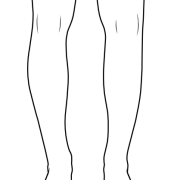
The illustration shows mild bowing. Bowing may become extreme in certain cases.
In bow legs the knees do not touch when standing or walking, although the feet may seem more or less normally aligned. Page updated January 2024 by Dr Sheila Strover (Clinical Editor)
The illustration shows mild bowing. Bowing may become extreme in certain cases.
In bow legs the knees are more widely apart than the rest of the leg. It is common in small children, who simply grow out of it, but in some people the bowing continues into adulthood.
Bowing ('varus deformity') may develop later in life, as arthritis breaks down the inner (medial) aspect of the knee joint, often due to a meniscus having been removed some years earlier ('medial compartment' arthritis). In countries where diet and health may be poor, bow legs may also occur from such things as scurvy.
Bow legs may be asymptomatic or can lead to damage or aggravation of damage in the knee due to the abnormal alignment forces.
"...cartilage or meniscal injury....can be magnified in the setting of limb malalignment as a result of abnormal loading and increased contact pressures."