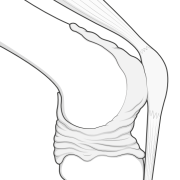
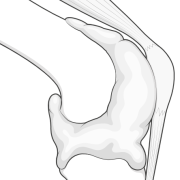
What does the knee capsule do?
The knee capsule is the water-tight fibrous casing enclosing the important structures inside the joint cavity.
"...It is a dense fibrous connective tissue that is attached to the bones via specialised attachment zones and forms a sleeve around the joint. It varies in thickness according to the stresses to which it is subject, is locally thickened to form capsular ligaments, and may also incorporate tendons...."
How does the capsule lubricate the knee?
The inner part of the capsule is lined with special cells - synovial cells - that secrete the fluid that lubricates the knee.
This allows smooth movement of the cartilage surfaces of the bones of the joint. The fluid also nourishes the structures inside the knee. The loose baggy folds also facilitate movement of the knee, but when the knee capsule is tense with fluid the knee cannot move so well and the person will experience stiffness in addition to pain.
"...[Synovial fluid] is an ultra filtrate of blood plasma that is concentrated by virtue of its filtration through the synovial membrane...The principal role of synovial fluid is to reduce friction between the articular cartilages of synovial joints during movement...."
Stiffness from capsular adhesions and contractures
Inflammation of the synovium causes the cellular layer to heap up into folds and little projecting fingers called villi. This is called synovitis. Sometimes the fragile villi can slowly bleed and give rise to a condition called pigmented villonodular synovitis.
Once the fluid has been aspirated or resorbed, unfortunately it may leave a residual stickiness called adhesions. Without adequate management adhesions may consolidate into scar tissue with marked and painful limitation of movement. This is called arthrofibrosis.
Particularly at the back of the knee the folds can 'glue' together, making it hard to fully extend the knee. The surgeon may choose to release the contracture via a procedure known as 'posterior capsulotomy'.