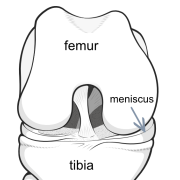
The two menisci are crescent-shaped and cushion the space between femur and tibia on either side of the joint.

This illustration shows a longitudinal tear of the meniscus, which is likely to result in instability.
A torn meniscus is a split through the fibres and matrix of the shock absorber of the knee. Page updated May 2024 by Dr Sheila Strover (Clinical Editor)
The two menisci are crescent-shaped and cushion the space between femur and tibia on either side of the joint.
This illustration shows a longitudinal tear of the meniscus, which is likely to result in instability.

A classic non-impact injury may be the result of the foot being planted while the body is twisted with force. In an older person, where there may be pre-existing degenerative changes, a relatively small event may lead to a tear.
Older patients with degenerative tears may not recall a recent specific injury, but may notice that the knee is often painful and may feel unstable.
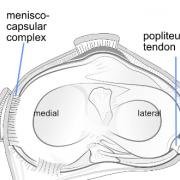
Lateral tears tend to have a worse outcome because:
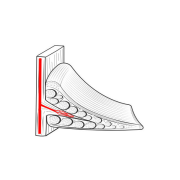
"The vascular supply of the knee joint plays a major role in the healing and repair....Therefore, identifying the correct location of the lesion will contribute to an optimal treatment plan.... "
If the surgeon assesses the meniscus tear and feels that it is in the patient's best interest to repair it, he/she can use sutures (stitches) or small devices shot through the torn edges and hold the edges together until healing occurs - this is called meniscal repair. If it is not feasible to repair a large tear, the surgeon may perform a partial meniscectomy or in desperate cases even a total meniscectomy.
"While conservative management has its role and can be indicated in cases with advanced osteoarthritis or in patients with small tears, partial meniscectomy continues to be the most performed procedure for meniscal injuries. While its efficacy is a matter of debate, its short learning curve and acceptable short-term results have deterred many orthopaedic surgeons to switch to more effective procedures. Meniscal repairs have grown in popularity over the past three decades...."
"Although meniscal repair has shown promising results and a low short-term failure rate, the long-term failure rate is reported to reach up to 30% consistently.... "