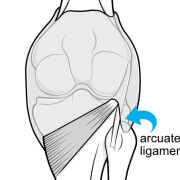
The ligament is really a thickening of the capsule, and it arcs over the tendon of the popliteus muscle and attaches to the fibula.
The arcuate ligament is a thickening of the posterolateral capsule at the back of the knee, that contributes to stability of the joint in this region. Page updated May 2024 by Dr Sheila Strover (Clinical Editor)
The ligament is really a thickening of the capsule, and it arcs over the tendon of the popliteus muscle and attaches to the fibula.
But where it is present, it plays an important role in stability of the posterolateral corner.
"....The arcuate complex with its most prominent part, the popliteofibular ligament, serves primarily as a static stabilizer against external tibial rotation....Together with the popliteus muscle tendon unit, which also functions as a dynamic stabilizer against external rotation, the arcuate complex prevents posterior tibial translation...."
"....Among the different structures of the posterolateral corner, only the arcuate ligament has a significant role in restricting excessive primary and coupled external rotation....The posterior cruciate ligament and the arcuate ligament have predominant role for the posterolateral stability of the knee. ...."
This is an important sign to recognise on an X-ray and may explain post-injury instability. Surgery to reattach the avulsed fragment can restore posterolateral corner stability.
"....The arcuate sign is a well described finding of fibular head avulsion [fracture] at the insertion site of the arcuate complex....[it] indicates an injury to at least one of the posterolateral corner structures of the knee....[with] resulting instability."