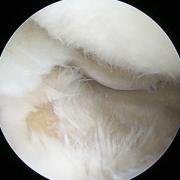
Fibrillar wear of the articular cartilage. You can see the yellowish bone showing on the top of the tibia.
Cartilage fibrillation is an advanced stage of articular cartilage damage, when the normally resilient material breaks down in feathery strands revealing the underneath bone. Page updated May 2024 by Dr Sheila Strover (Clinical Editor)
Fibrillar wear of the articular cartilage. You can see the yellowish bone showing on the top of the tibia.
In osteoarthritis, however, complex chemical changes wake the chondrocytes up from their apparent dormancy, and a cascade of chemical events creates 'a soup' of inflammatory chemicals and a disruption of the normally quiescent components of the matrix, and disruption of the fibrils within it.
"....The composition and cellular organization of healthy human adult articular cartilage....is more complex than it looks....[Breakdown of cartilage is due] either to the adverse effects of trauma or overloading (e.g., injury and obesity) on otherwise normal cartilage or normal loading on abnormal cartilage (e.g., genetic defects and aging)...."
"....Cartilage alterations in [osteoarthritis] mainly concern an imbalance in tissue remodeling due to changes in [cartilage cell] behaviour...."
If stem cells are encouraged to enter the area (eg via a microfracture procedure) then some healing may occur, although the quality of cartilage may not be as good as the original.
Most modern cartilage repair procedures involve growing new 'cartilage tissue' in a laboratory and transplanting it back into the defect, where microfracture may have prepared the recipient area for stem cells to also migrate into the area.
Chondrocyte, Matrix, Cartilage repair, Microfracture, Stem cells, Outerbridge classification, Noyes classification