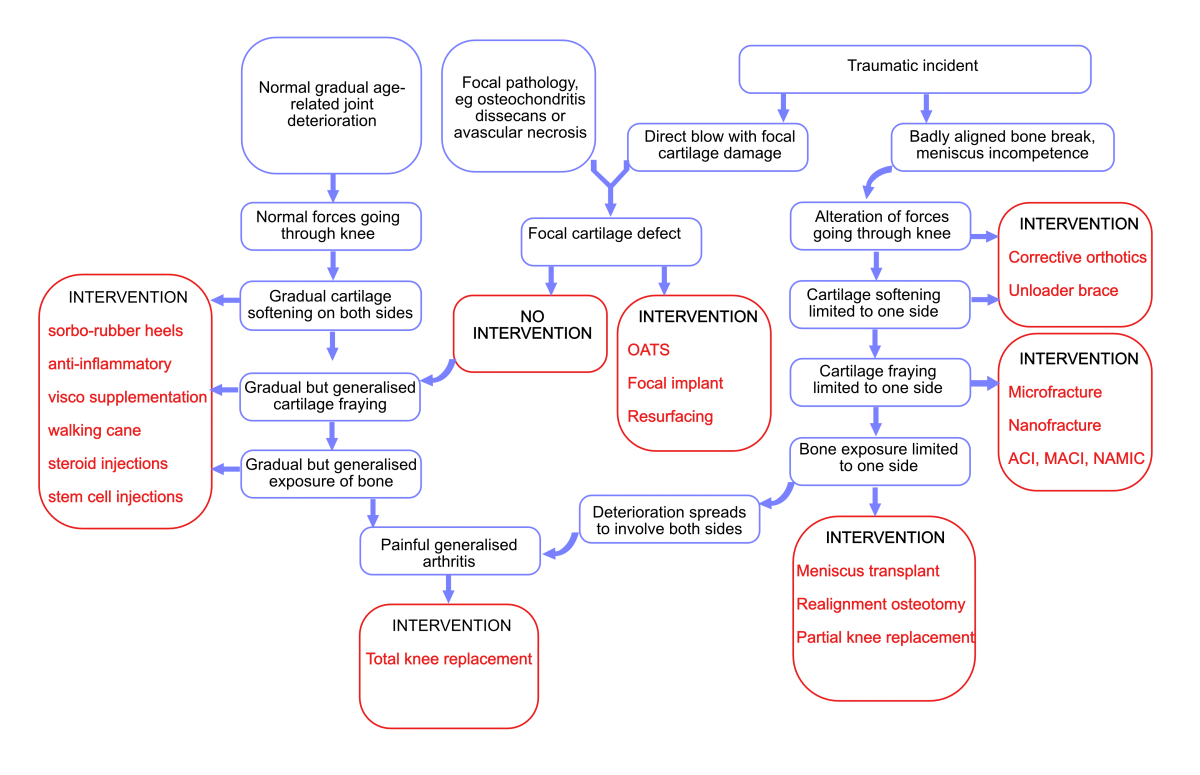
Smoothing rough and damaged surfaces
Damaged joint cartilage has an extremely limited ability to heal itself, and also produces enzymes that may actually make the damage worse.
By smoothing out the loose fragments, the destructive cascade may lessen.
"....Articular hyaline cartilage is extensively hydrated, but it is neither innervated nor vascularized, and its low cell density allows only extremely limited self-renewal...."
Importing stem cells
Stem cells have the potential to transform into other specialised cells according to the tissue's need.
They may be encouraged to enter the damaged area by poking small holes into the underlying bone marrow, through which the stem cells can migrate.
Stem cells can also be cultured in a laboratory and injected back into the joint.
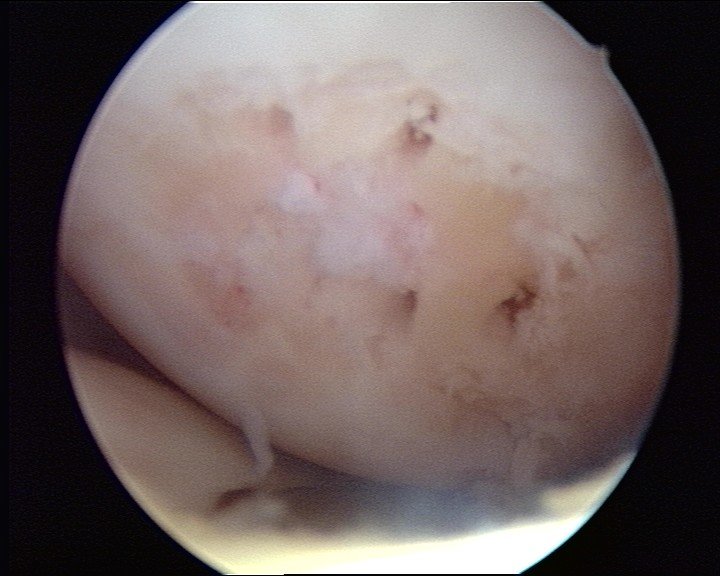
The marrow-stimulation technique of microfracture employs a small pick to create tiny holes through the hard base layer of the damaged area, allowing blood and the patient's own stem cells to enter the area and start the healing process.
Nanofracture is similar but uses a smaller-gauge pick.
"....disrupting the subchondral bone integrity....is only effective for small defects, and moreover, provides relatively short-term functional improvement due to the formation of fibrocartilage rather than hyaline articular cartilage...."
Transporting and transplanting plugs of mature cartilage
These techniques are known as cartilage transfer, and don't involve the laboratory.
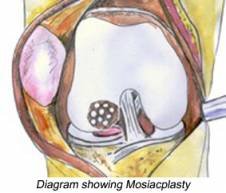
Mosaicplasty is a 1-stage technique of osteochondral implantation, where larger defects are packed with small plugs of bone and cartilage taken from a less essential part of the joint.
Adding cultured cartilage cells
Because the cells in mature cartilage are held in suspension within a cartilage matrix, laboratory techniques are employed to extract them from healthy samples of cartilage, multiply them in culture, and then inject them back into the joint.
Techniques include Autologous Chondrocyte Implantation (ACI) and Mosaicplasty.
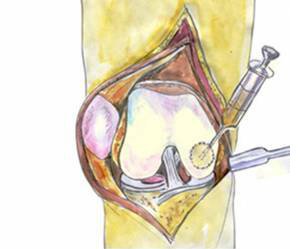
Autologous cartilage implantation (ACI) is a 2-stage cartilage repair procedure where cartilage cells are harvested and multiplied in a laboratory before being returned to the patient and injected behind a membrane.
"....The challenges associated with osteochondral allograft transplantation include proper storage of the allograft, tissue availability, the possibility of an immunologic response by the recipient, and demanding surgery...."
Other relevant links
Debridement, Abrasion arthroplasty, Marrow stimulation, Progenitor cells, Stem cells, Microfracture, Nanofracture, Autologous matrix-induced chondrogenesis (AMIC), Nanofracture Autologous Matrix-Induced Chondrogenesis (NAMIC), OATS, Mosaicplasty, Osteochondral graft, Osteochondral allograft, Autologous chondrocyte implantation (ACI), Matrix-induced Autologous Chondrocyte Implant (MACI)
Forum discussions
- Does BUPA cover MACI/ACI surgery - Patients in the UK discuss payment by health insurers for cartilage repair procedures.